

The real Isabel Ferrando
All truths being equal... these are some damned-fine wines.

This article is also available on Hudin.com to Personal & Commercial subscribers as well as the in-depth Châteauneuf-du-Pape Report for 2026.
There exist several wine brands which have taken on the names of historic women and in the process, grown to rather mythic status with time. Perhaps the most famous is Barbe-Nicole Ponsardin aka Veuve Clicquot. She definitely deserves a far better and more accurate film of her life someday, but her name (or at least the widowed version of it) graces one of the most iconic Champagnes there is. Then, at the other end of the spectrum there’s Anna de Codorníu from the Cava ‘Jumbotron’, Codorníu and is, a ‘different’ kind of sparkling described generously in a review once as having, a “somewhat flat-feeling finish.”
While both Barbe-Nicole and Anna did exist, I feel that their names (much as perhaps is the case with Dom Perignon) are used more to market wines than actually tell a real story. Despite my personal aversion to this, it continues with other wines brands at varying levels and probably won’t stop any time soon.
This is why, via the first time I fully tasted the Châteauneuf-du-Pape wines from “Isabel Ferrando” about two years ago, I thought that this perhaps was perhaps another such name. Given, the distinctly Spanish aspect to her name, I’d even invented a backstory that she was probably an 18th-century Flamenco dancer from Jerez de la Frontera who, upon killing her philandering husband one night, stole a horse and fled to the wilds of Provence. Once there, she managed to win a wine estate via a game of cards which she’d rigged. And, I continued to imagine that all the marketing materials in the present day would then state, “The wines produced today pay tribute to this legacy.”
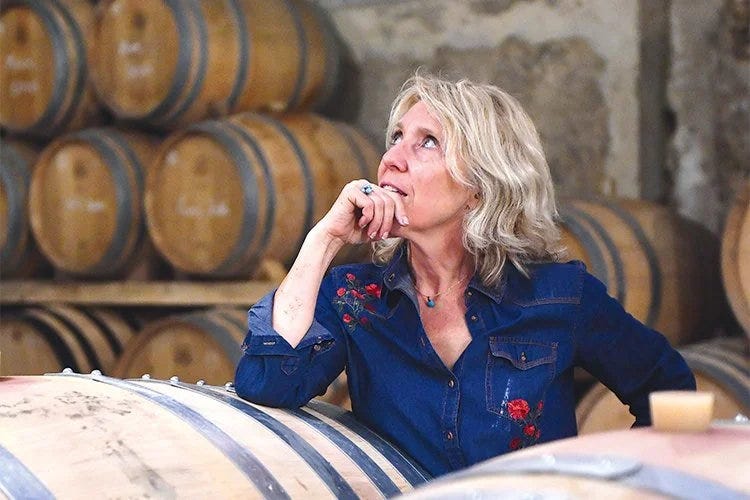
Of course I did finally meet the real Isabel Ferrando.
Ferrando, despite the surname, isn’t herself originally from Spain, but is in fact provençale. After a career in banking she decided to return to her native lands in 2003, bought the Domaine Saint Préfert (which was founded in 1920) and proceeded to start up her own winery. It should be noted that she did this with no family history in winemaking and had to learn everything from scratch with the help of Henri Bonneau as well as Lucien Michel of Domaine du Vieux Donjon.
Then, after a century of being known as Domaine Saint Préfert, Ferrando changed the winery name to Famille Isabel Ferrando in 2020 and her daughter, Guillemette joined the winemaking team in 2023, so it it isn’t a ‘famille’ project and that isn’t just marketing either.
Arriving to the estate is pure Châteauneuf as you come to what is quite literally, the end of the road with just vines and the treeline of islands in the Rhône River in front of you. Hopping out of the car you see a classic, creamy-stone estate in that sunbaked, Provence style seen in any Instagram account for rosé. After absorbing the house for minute, when you turn around and look the opposite direction, across their vines sits the ruins of the “new castle”, perched atop its little hill above the village.
Now, there is no shortage of women winemakers/owners in France, but at the same time, for anyone to build up an estate from scratch requires an very certain kind of energy and drive. When you meet Ferrando, she immediately exerts this and it’s clear to understand how she accomplished all that she has. As we tasted through the wines with members of her team and then sat down for a local lunch she prepared (which I appreciated tremendously as it was unstuffy, delicious food) it also became clear that Ferrando doesn’t just have drive, but also a keen ability to manage. There was this holistic sense to how everyone worked together in an organic fashion. I’ve seen this only in the best-run wineries as with others, it’s more a sense that the employees are supplicants to owner. I will say that whether it’s one case or the other, the wines directly reflect the situation of the team.
You can see this in the wines below, as the Saint Préfert Blanc and Rouge show the winery team’s mastery of assemblage. They’re excellent wines, using the core varieties from Châteauneuf in their best form. But for me, what are even more impressive are the varietal wines from Clairette(s), Grenache, and Cinsault.
Châteauneuf is the only appellation in Southern Rhône that allows producers to use any percentage of their 18 permitted red, gris, and white grape varieties as they see fit. There aren’t terribly many wines made with just one grape variety however given that the climate is so aggressively hot and soils so varied that a balance of various pieces is usually needed to create the fine wines of precise power that the region is known for. Ferrando bucks the trend with this series of varietal wines, especially the Clairette Blanche & Clairette Rose blend. They show a wonderful purity and consistency that she’s managed to arrive at in her 20+ years of building up the estate.
And while I greatly admire what’s seen in the varietal wines, the reality is that there’s no going wrong with truly any of the wines. Despite rather rough vintages climatically, they’ve managed to continue to produce excellent wines thanks to this project started by the very real Isabel Ferrando.
Cuvée Spéciale Vieilles Clairettes 2025 - Soft white pear notes with a delicate touch of rose petal and light, delicate chalky notes at the base. Full and ample on the palate, beautifully wild, but still polished and shows the potential for these white varieties in the region and makes the case as to why neighboring Gigondas Blanc requires a minimum of Clairette at its base.
Colombis 2024 - Light wild strawberry with some softer chalky notes at the base and delicate white pepper notes, light thriving plum peel at the base. Grippy and lengthy on the palate, defies the vintage overall giving a great deal of finesse and showing that a varietal Grenache wine definitely has its place in Châteauneuf.
F601 2024 - Pressed wild red strawberry with some softer rosemary, thyme, even a touch of lavender, and steeped black tea leaf. Grippy and fresh, broad but with a delicate, expressive length to it. This is everything wonderful about varietal Cinsault and is proof that there’s a great deal of potential for this variety in a changing, more extreme climate.
Saint Préfert Blanc 2025 - Light citric peel with a touch of softer lemon and green apple notes at the base, lightly chalky and softer gravel notes at the base. Fresh and lively on the palate with clean green apple notes in the finish. A really pleasing blend of 70% Clairette Blanche and 30% Roussanne.
Saint Préfert Rouge 2024 - Plum peel and light wild strawberry, with a delicate dusting of pepper and soft cocoa notes. Fresh and crisp on the palate with fine, jumpy tannins in the finish. The most complex assemblage of the lot being 70% Grenache, 20% Cinsault, and the rest of the balance seen in Mourvèdre, Syrah, and Counoise. Very nicely executed.
Full scores and additional reports available on Hudin.com to Personal & Commercial subscribers.